Research
My research develops physics-informed and data-driven methods to model, estimate, and secure traffic dynamics across large-scale transportation networks. The four directions below share a common foundation in network traffic dynamics and a common methodological core in physics-informed learning, optimization, game theory, and behavioral modeling.
Hover or focus a research area to see how it connects to the shared foundation and methods.
Physics-Informed AI
I embed traffic-flow theory into machine learning to model and estimate traffic dynamics at the network scale. This work includes physics-informed formulations of macroscopic models such as the generalized bathtub model for large-scale urban networks, graph learning guided by the network macroscopic fundamental diagram for traffic state imputation, and observation-aligned two-stage domain decomposition for estimating traffic states from sparse fixed sensors, aiming at scalable inference that stays reliable where data are limited.
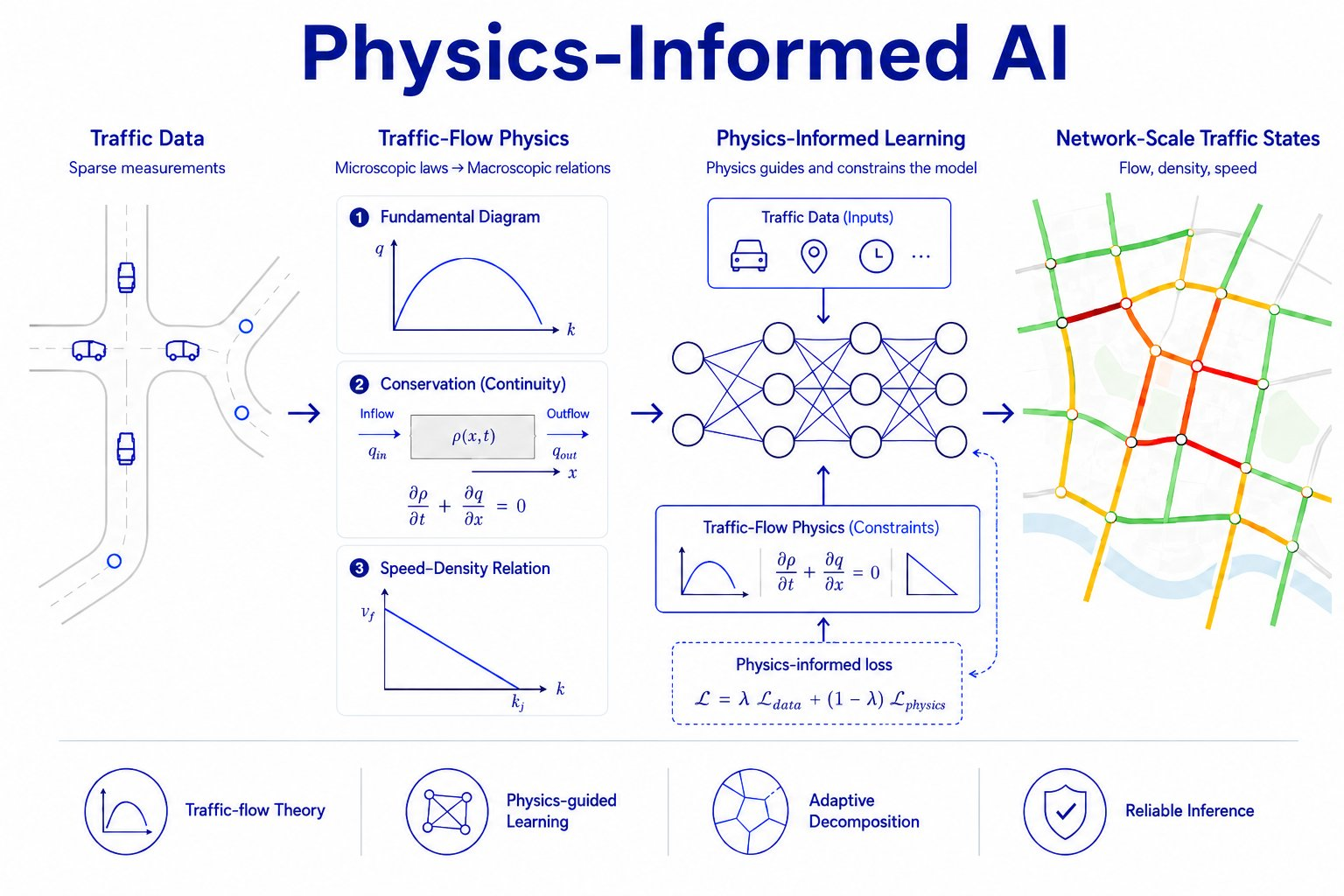
- AcceptedObservation-Aligned Two-Stage Domain Decomposition for Physics-Informed Traffic State Estimation with Sparse Fixed SensorsTransportation Research Part C: Emerging Technologies (Accepted), 2026. DOI: 10.48550/arXiv.2605.08028
- TR Part CA Physics-Informed Machine Learning for Generalized Bathtub Model in Large-Scale Urban NetworksTransportation Research Part C: Emerging Technologies, 2024. DOI: 10.1016/j.trc.2024.104661
- TR Part BNetwork Macroscopic Fundamental Diagram-Informed Graph Learning for Traffic State ImputationTransportation Research Part B: Methodological, 2024. DOI: 10.1016/j.trb.2024.102996
Network Resilience
I study how transportation networks absorb and recover from disruption. My work quantifies how climate-driven and cyber disruptions propagate through networks, how reliability degrades under such events, and how operations can be designed for faster and more dependable recovery, with a focus on reliability- and recovery-oriented modeling and decision support at the city scale.
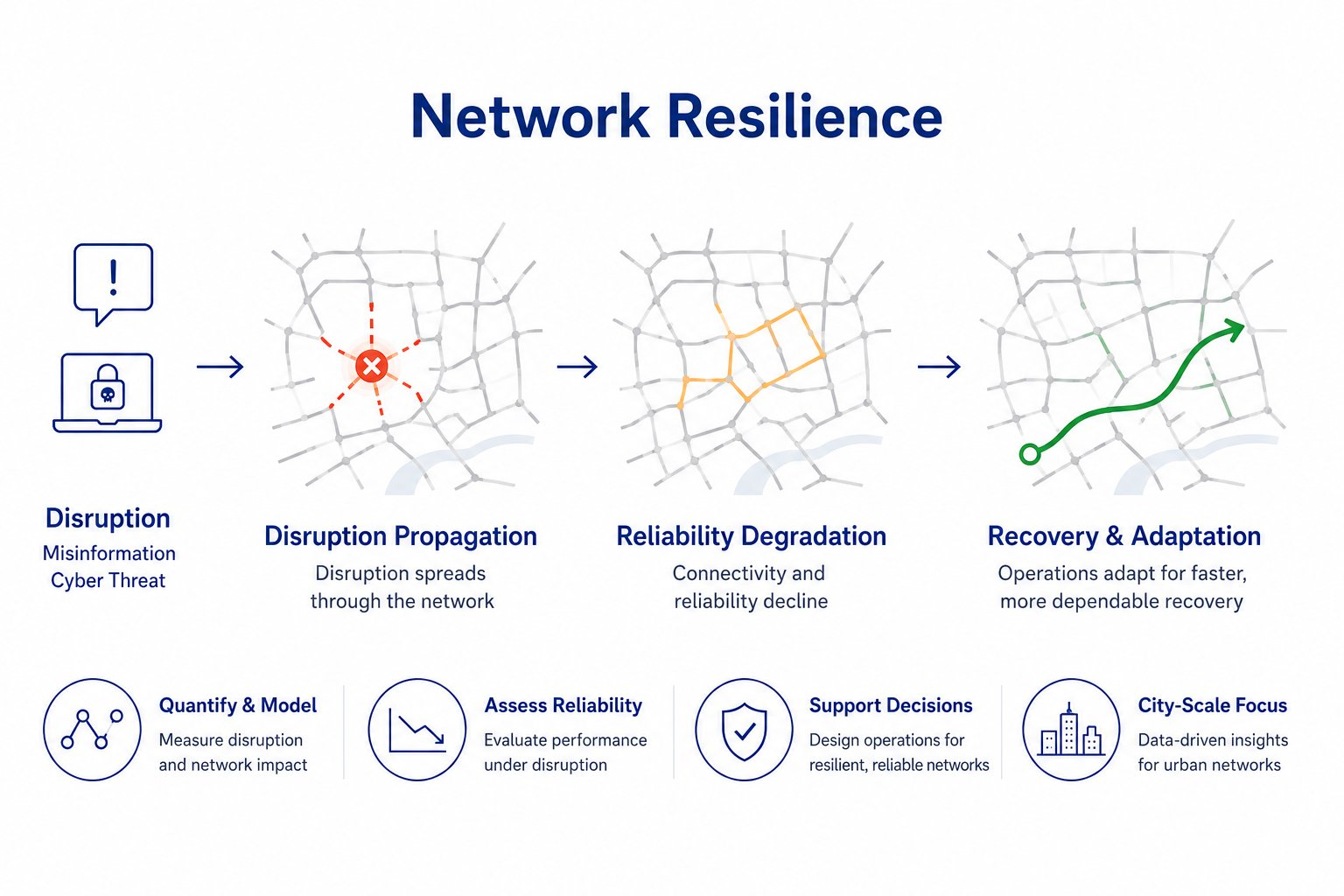
- Transportmetrica BResilience of Traffic Networks to Route Guidance Attacks: The Role of Driver Behaviour HeterogeneityTransportmetrica B: Transport Dynamics, 2026. DOI: 10.1080/21680566.2026.2674257
- Under reviewDay-to-Day Traffic Network Modeling under Route-Guidance Misinformation: Endogenous Trust and Resilience in CAV EnvironmentsIEEE Transactions on Intelligent Transportation Systems (under review), 2026. DOI: 10.48550/arXiv.2605.14204
Transportation Cybersecurity
I model and mitigate cyber threats to connected and autonomous mobility. This spans route guidance attacks that manipulate driver routing and their behavioral and network-level effects, detection of V2X attacks such as fake emergency messages, and a broader review of cybersecurity needs for next-generation road transportation, with defenses judged by their network-level outcomes.
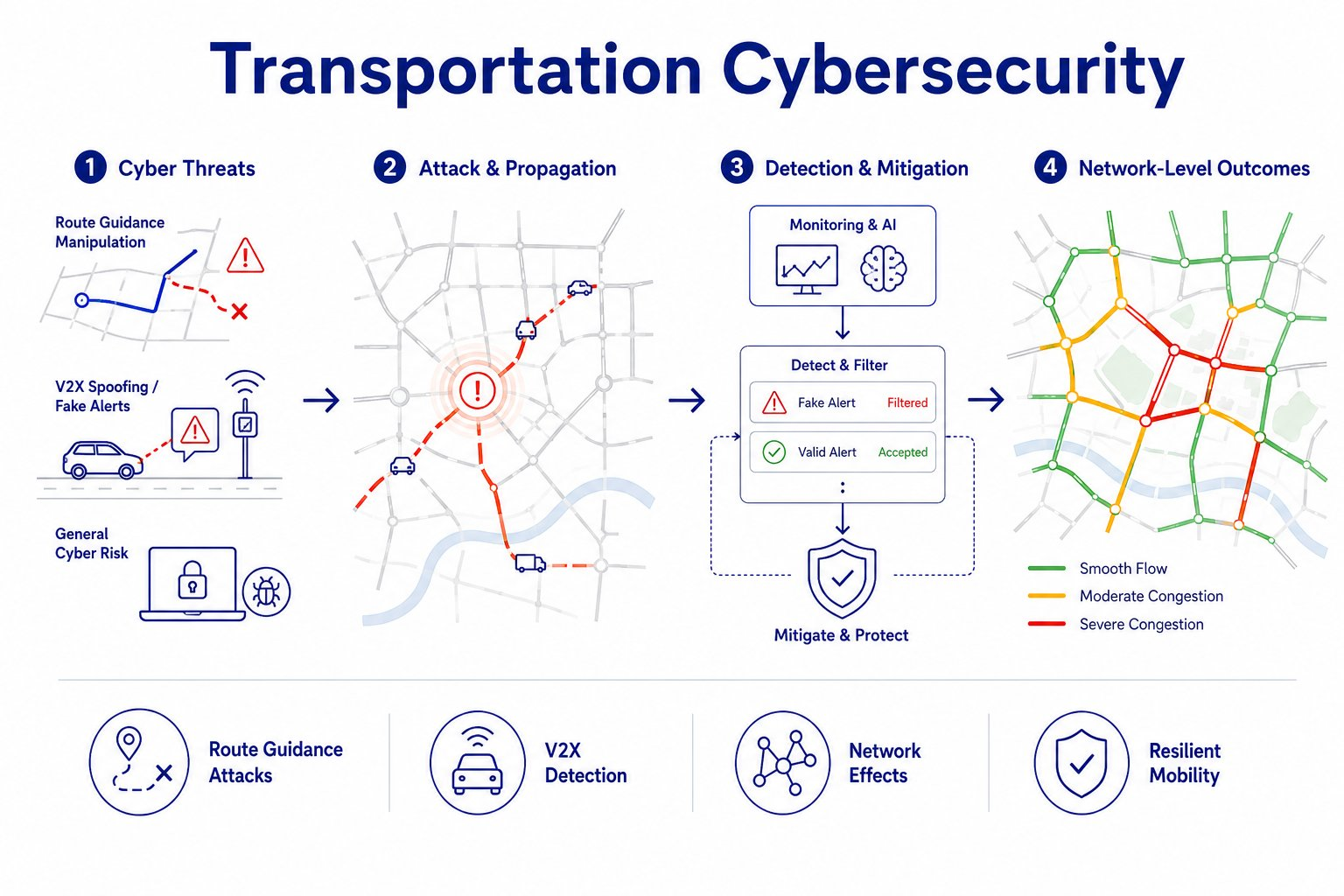
- VehicleSecMIRAGE: Detecting Fake Emergency Electronic Brake Light Attacks in V2X Networks via Event-Gated Behavioral AnalysisIn 4th USENIX Symposium on Vehicle Security and Privacy (VehicleSec ’26), Baltimore, MD, 2026
- TR Part FRoute Guidance Attacks in Cyber Transportation Networks: A User-Centered Study of Behavioral SensitivityTransportation Research Part F: Traffic Psychology and Behaviour, 2025. DOI: 10.1016/j.trf.2025.103354
- ACM JATSCybersecurity for Next-Generation Road Transportation: A ReviewACM Journal on Autonomous Transportation Systems, 2025. DOI: 10.1145/3744352The first four authors contributed equally to this research
Optimization & Human Behavior
I combine optimization, game theory, and behavioral modeling to study how travelers route and respond in mobility systems. This includes mean field routing games for connected and autonomous vehicles, analytical network-flow frameworks for traffic under route guidance attacks, and empirical studies of driver behavior such as gap acceptance and surrogate safety measures, connecting individual behavior to network-level performance.
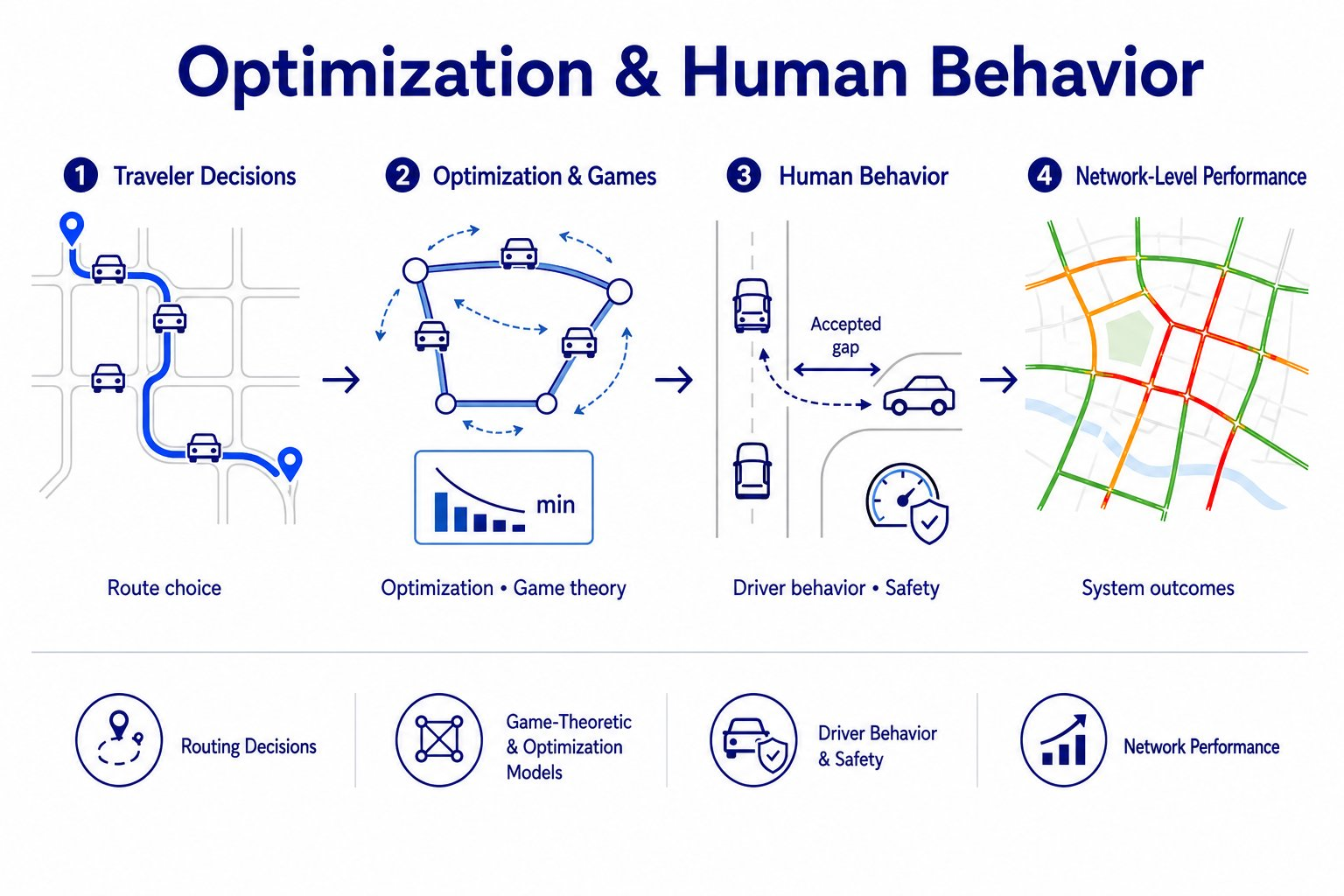
- INFORMSDynamic Routing Games for Connected and Autonomous Vehicles with Traffic Congestion: A Mean Field Game ApproachIn 2023 INFORMS Annual Meeting, Phoenix, AZ, 2023
- JTE Part ALeveraging Location-Based Data for Assessing Network-Level Traffic Impact of Lane Management: A Case Study of Alex Fraser Bridge2022 Editor’s Choice CollectionJournal of Transportation Engineering, Part A: Systems, 2022. DOI: 10.1061/JTEPBS.0000760
- J. Adv. Transp.Implementing Surrogate Safety Measures in Driving Simulator and Evaluating the Safety Effects of Simulator-Based Training on Risky Driving BehaviorsJournal of Advanced Transportation, 2020. DOI: 10.1155/2020/7525721
- J. Adv. Transp.Evaluation of the Rain Effects on Gap Acceptance Behavior at Roundabouts by a Logit ModelJournal of Advanced Transportation, 2018. DOI: 10.1155/2018/2726732
Research Funding
Awarded / Participated
Led full proposal development as Graduate Research Assistant (PI: Dr. Satish V. Ukkusuri), from conceptualization and writing through submission, and contributed to project execution.
- Attracting and Retaining the Transportation Workforce and At-Risk Targeted Areas
- A Multi-Resolution Simulation Platform for Transportation System Security Testing and Evaluation
- Training Gap Analysis for INDOT Workforce
Submitted / In Preparation
- Resilience-Based Prioritization Framework for Cooperative UAV–UGV Road Maintenance
Research Support
- Google Cloud Research Credits